

Chandrasekhar Kutty, Founding Partner, Sashthi Taxlegal Advisory Services LLP | GST Litigation • Advisory • Appellate Representation | Hosur • Bengaluru
28 October 2026
The CGST (Amendment) Rules, 2026, notified by Notification No. 05/2026-Central Tax dated 26.10.2026 under section 164 of the CGST Act, are the largest rewrite of the registration chapter since 2017, and they reach well beyond registration. Ninety-eight pages long, mostly substituted forms, the notification brings in registration through an e-commerce operator’s warehouse, fixed timelines with deemed approvals for amendment, cancellation and revocation, a formal objection route against blocking of credit under rule 86A, removal of the 1.5 times cap on export turnover in refund claims, and, from April 2027, refund of input tax credit on capital goods. The general commencement date is 1 November 2026, the same day sections 153 to 155 of the Finance Act, 2026 take effect; several provisions are deferred to 1 December 2026 and 1 April 2027.
Registration through an e-commerce operator’s warehouse: new rule 14B
A person registered in one State may now obtain a registration on the same PAN in another State where it has no physical presence, by declaring the warehouse of an electronic commerce operator required to collect tax at source under section 52 as its principal place of business. Three conditions apply: the person must intend to supply goods through that operator; the output tax liability on supplies to registered persons (other than to persons on the same PAN) must not exceed Rs 2.5 lakh per month; and the operator must consent to the declaration.
The application in FORM GST REG-01 declares the home-State GSTIN, is forwarded to the operator for consent within seven working days, and then to the jurisdictional officer of the home State for biometric Aadhaar authentication, document verification and physical verification of the home-State premises. If the officer does not act within thirty days of the ARN, the registration is deemed approved. The rule provides for withdrawal in REG-32, amendment of the warehouse address in REG-14 with fresh operator consent, deemed cancellation in REG-38 where the operator withdraws permission and the person does not amend within thirty days, and a bar on a second rule 14B registration in the same State on the same PAN. Persons who have not opted for Aadhaar authentication are not eligible, and the certificate need not be displayed at the operator’s warehouse.
Amendment, cancellation, suspension and revocation: rules 19 to 23A
| Rule | What changes | Effective |
|---|---|---|
| Rule 19 – amendment of registration (substituted) | Changes to the principal place of business go to the proper officer, who must approve in REG-15 or issue REG-03 within fifteen days; reply in REG-04 within seven working days; deemed approval if the officer does not act within fifteen days of the application or seven working days of the reply. Changes to the authorised signatory’s mobile or e-mail need online verification; a change in PAN needs fresh registration. | 1 Nov 2026 (sub-rule (3) for rule 14A registrants: 1 Dec 2026) |
| Rule 20 – cancellation on request (substituted) | REG-16 within thirty days of the event (not for death of a sole proprietor); all returns up to the date of application must be filed, including GSTR-3B for every period for which GSTR-1 or IFF is filed; registration suspended on filing. The portal cancels electronically in REG-38 where returns are in order and the monthly B2B output tax never exceeded Rs 2.5 lakh, or GSTR-10 is filed within three days of the due date. Other cases: officer must cancel in REG-19 or issue REG-03 within fifteen days, with deemed approval on inaction. New sub-rules (14) to (20): a show cause process in REG-34 to REG-37 before the effective date of cancellation can be moved earlier under section 29(3), with a sixty-day outer limit after which proceedings are deemed dropped, and no second change of date. | 1 Nov 2026 |
| Rule 21 – grounds for cancellation (substituted) | Composition taxpayer not filing the annual return beyond three months; violation of the third or fourth proviso to rule 23(1); monthly filer in default for six months; quarterly filer in default for two tax periods; violation of rule 10A on bank account details. | 1 Nov 2026 |
| Rule 21A – suspension (substituted) | Suspension by the officer on initiating cancellation, or electronically by the portal for the return and rule 10A defaults, with REG-31 giving thirty days to comply; deemed revoked on compliance within that period. | 1 Apr 2027 |
| Rule 22 – cancellation by officer (substituted) | REG-17 notice with seven working days to reply in REG-18; drop in REG-20 or cancel in REG-19 within thirty days of the reply or its due date. A person suspended by the portal who does not comply within thirty days is deemed cancelled electronically, intimated in REG-38. | 1 Apr 2027 |
| Rule 23A – revocation of system cancellation (new) | Application in REG-21 within 180 days, provided pending returns are filed and dues paid, or bank details furnished; deemed approved on compliance with REG-22 issued by the portal; returns from cancellation to revocation to be filed within thirty days. | 1 Apr 2027 |
Blocking of credit under rule 86A: a formal objection route
From 1 April 2027, rule 86A is restructured. The power to disallow debit of the electronic credit ledger vests in the proper officer, and the disallowance must be by an order in FORM GST DRC-26 made available on the common portal. The order lapses after one year, or earlier if the officer, being satisfied that the conditions no longer exist, allows debit by order. The registered person may object in FORM GST DRC-27 that the debit was or is not liable to be disallowed, and the officer must, after a reasonable opportunity of being heard, pass an order in FORM GST DRC-28 either allowing the debit (Part A) or rejecting the objection (Part B).
This codifies what the High Courts have been saying in Samay Alloys India P Ltd (Gujarat High Court, 03.02.2022) and Parity Infotech Solutions P Ltd (Delhi High Court, 07.03.2023): rule 86A is a drastic, temporary measure to be exercised on recorded reasons, with a post-decisional hearing. A blocking after 1 April 2027 that is not in DRC-26, or an objection in DRC-27 that is not decided in DRC-28 after a hearing, will be vulnerable on that ground alone. Until that date the existing rule, and the case law under it, continue to govern.
Refunds: rules 89 to 92
- The 1.5 times cap goes. The words in rule 89(4)(C) limiting the turnover of zero-rated supply of goods to 1.5 times the value of like goods supplied domestically are omitted with effect from 1 November 2026. The cap, inserted in March 2020, has produced a steady stream of refund rejections and writ petitions; its removal is prospective, but it strengthens the argument in pending matters that the cap was a measure of administrative convenience rather than a condition of entitlement.
- Capital goods credit becomes refundable from 1 April 2027. “Net ITC” in the zero-rated formula under rule 89(4), and the inverted duty formula under rule 89(5), will include input tax credit on capital goods attributable to the relevant period. A new clause (G) defines this as one-sixtieth of the eligible credit per month over sixty months, less reversals, for capital goods on which credit was availed on or after 1 April 2027. “Eligible input services” for the inverted duty formula means input services on which credit was availed on or after 1 November 2026.
- Order of debit prescribed. Rule 89(3) is substituted: integrated tax is debited first to the extent available, then central and State tax equally, with any shortfall in one ledger debited from the other.
- Documents recast from 1 December 2026. Rule 89(2) moves from “number and date” of invoices to “details” of invoices; new clause (ha) requires a statement of invoices and shipping bills where goods were supplied to a merchant exporter under Notifications 40/2017-CT(R) or 41/2017-IT(R) and refund is claimed under clause (ii) of the first proviso to section 54(3); new clause (n) requires a statement of inward invoices with ITC details for inverted duty claims; new clause (o) requires a declaration that the applicant has not been prosecuted for evasion above Rs 2.5 crore in the preceding five years for inverted duty and zero-rated-with-payment claims; and clause (p), from 1 April 2027, a declaration that capital goods in the claim have not been sold or removed. The words “either directly or through a Facilitation Centre” are omitted from sub-rules (1) and (1A).
- Deemed acknowledgement. Rule 90(2) reduces fifteen days to ten; new rule 90(3A) deems an application acknowledged in RFD-02 if neither RFD-02 nor a deficiency memo in RFD-03 issues within ten days of filing, with the sixty-day period under section 54(7) running from the date of filing.
- System-generated provisional refund. Rule 91(2) is substituted: the common portal, on system-based risk evaluation, generates the provisional refund order in RFD-04 within three working days of acknowledgement, and the order does not require revalidation by the proper officer. RFD-05 may issue through the portal.
- Rule 92. A new sub-rule (1B) provides a portal-generated RFD-06 where refund is due under section 49(6); sub-rule (4) is substituted to provide for electronic credit to any bank account in the registration particulars on a consolidated payment advice.
Other amendments
Rules 36 and 39 are amended so that credit may be distributed by an Input Service Distributor on the documents in rule 36, central tax is added alongside integrated tax in rule 39(1)(i), and “common” is dropped from rule 39(1A); rule 54(1A) speaks of input services attributable to distinct persons rather than common services; rule 60(2) extends GSTR-2A auto-population to the ISD in GSTR-6A. Rule 44 is amended from 1 December 2026 to drop the reference to section 18(5) and add REG-16 as a document for credit reversal on cancellation. Rule 62(5) replaces April with June and rule 63 replaces twenty days with thirteen. A new rule 83C provides for amendment of a GST practitioner’s enrolment through REG-14. Rule 86(3) now debits the ledger “in the manner prescribed in rule 89(3)”. Rule 138(2A) adds metro railway to the railways provision on e-way bills. Rule 159 refers to Part A of DRC-22 for provisional attachment and allows rejection of an objection in Part B. Table 5 of CMP-02 and CMP-08 is recast, and CMP-08 now reports outward supplies of services through an e-commerce operator liable under section 9(5) separately, with an instruction that composition taxpayers do not pay tax on such supplies but include them in aggregate turnover. FORM GST REG-01 is substituted, and the balance of the notification carries substituted or new forms in the REG, RFD and DRC series.
Effective dates at a glance
| Date | Provisions |
|---|---|
| 1 November 2026 | Rule 14B; rules 19 (except sub-rule (3)), 20, 21, 36, 39, 54, 60, 62, 63, 83C, 86; rule 89 except the clauses below, including omission of the 1.5 times cap; rules 90, 91, 92, 138, 159; substituted forms. |
| 1 December 2026 | Rule 19(3) for rule 14A registrants; rule 44; recast rule 89(2) with new clauses (ha), (n) and (o). |
| 1 April 2027 | Rules 21A, 22 and 23A; restructured rule 86A with DRC-26, DRC-27 and DRC-28; capital goods credit in rule 89(4) and (5); declaration in rule 89(2)(p). |
What businesses and practitioners should do now
- Review pending cancellation applications and refund claims against the new timelines; from 1 November 2026, inaction by the officer within the prescribed period works in the taxpayer’s favour, and that should be recorded and relied upon.
- Exporters whose refund claims were cut down by the 1.5 times cap should file claims for periods from 1 November 2026 without the cap, and consider citing the omission in pending appeals.
- Plan capital goods procurement with the April 2027 date in view: credit availed on or after 1 April 2027 enters the refund formulas; credit availed earlier does not.
- Merchant-export suppliers and inverted duty claimants should prepare the statements required by the new clauses (ha) and (n) of rule 89(2) before 1 December 2026.
- Where credit is blocked under rule 86A on or after 1 April 2027, insist on DRC-26 and file DRC-27 promptly; where it is blocked before that date, the existing case law on reasons and hearing continues to apply.
- E-commerce sellers should evaluate rule 14B for States where they currently route supplies through the home-State registration or have no registration at all.
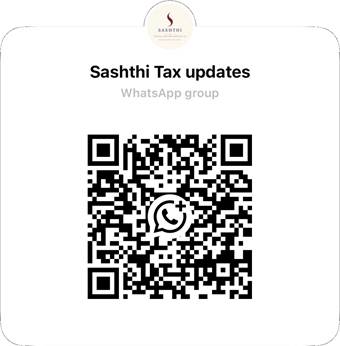
Join the Sashthi Tax Updates WhatsApp group
Get free GST updates on your phone. Scan the QR code to become a member – free, or join via https://chat.whatsapp.com/G7xFSIvZADlKXa1HJRln5m.
For advice on how these rules affect your business or a pending dispute, write to contact@sashthitaxlegal.com or call +91 99521 84110.
Source: Notification No. 05/2026-Central Tax dated 26.10.2026 [F. No. CBIC-20001/1/2026-GST], the Central Goods and Services Tax (Amendment) Rules, 2026, issued under section 164 of the CGST Act, 2017. This summary is drawn from the rules text of the notification; the substituted forms have not been analysed. The article is for general information and does not constitute professional advice. Readers should obtain specific advice before acting on any matter discussed here.