

Chandrasekhar Kutty, Founding Partner, Sashthi Taxlegal Advisory Services LLP | GST Litigation • Advisory • Appellate Representation | Hosur • Bengaluru
28 October 2026
From 1 January 2027, e-invoicing will no longer stop at B2B supplies and exports. Notification No. 04/2026-Central Tax dated 26.10.2026 amends Notification No. 13/2020-Central Tax so that the self-invoice a registered person raises for supplies received from an unregistered person under reverse charge, and for import of services, must also be reported to the Invoice Registration Portal and carry an Invoice Reference Number. For every business already within the e-invoicing threshold, the reverse charge ledger moves from the back office to the common portal.
What the notification does
Notification 13/2020-Central Tax is the parent notification under rule 48(4) of the CGST Rules that identifies who must prepare invoices in the e-invoice manner. Its first paragraph has so far applied to supplies of goods or services or both “to a registered person or for exports”. Notification 04/2026, issued on the recommendations of the Council, substitutes that phrase with four categories:
- supply of goods or services or both to a registered person;
- supply of goods or services or both for exports;
- supply of goods or services or both received from an unregistered person where the tax is payable on reverse charge basis by the recipient; and
- import of services.
The notification comes into force on 1 January 2027. The aggregate turnover threshold in Notification 13/2020 is not changed; the amendment widens the transactions covered, not the class of persons.
Why self-invoices are being brought in
Section 31(3)(f) of the CGST Act requires a registered person liable to pay tax under reverse charge on a supply from an unregistered supplier to issue an invoice for that supply. Import of services from an overseas supplier falls in the same position, since the Indian recipient is the person liable to pay the tax. Rule 47A, inserted in 2024, requires that self-invoice to be raised within thirty days of receipt of the supply.
Until now these documents have lived only in the recipient’s accounting system. Reverse charge liability is reported in Table 3.1(d) of GSTR-3B and the credit is taken in Table 4 of the same return, with no document on the portal against which either entry can be matched. The amendment closes that gap: from 1 January 2027 the self-invoice itself will be a portal-validated document with an IRN, and the time of supply under section 13(3), the payment of tax and the input tax credit on the transaction will all trace back to it.
Transactions that will be affected
| Category | Typical reverse charge transactions caught from 1 January 2027 |
|---|---|
| Services from unregistered persons under section 9(3) | Legal services from advocates and firms of advocates; goods transport agency services where the GTA has not opted to pay tax; security services from non-corporate providers; sponsorship; services of an arbitral tribunal; renting of residential dwelling to a registered person; services supplied by a director in that capacity |
| Goods from unregistered persons under section 9(3) | Cashew nuts, bidi wrapper leaves, tobacco leaves, raw cotton and similar notified goods purchased from agriculturists; metal scrap from unregistered suppliers |
| Supplies under section 9(4) | Inputs and input services received by promoters from unregistered persons for residential projects |
| Import of services | Software subscriptions, cloud services, royalties, management fees and technical services received from overseas group companies, vendors and consultants, including those paid through corporate cards |
Points to watch
- Software readiness. Most ERP and billing systems generate e-invoices only from the sales module. The self-invoice is a purchase-side document and will need to be mapped to the e-invoice schema as a document issued by the recipient, with the recipient’s own GSTIN as the supplier field and the unregistered supplier’s details, or the overseas supplier’s details, in the place prescribed by the schema. Vendors will need the two-month window.
- Thirty-day limit under rule 47A. The time limit for raising the self-invoice does not change, but a late self-invoice will now be visible on the portal with its generation date. Credit on a self-invoice raised beyond thirty days will be an obvious target in scrutiny.
- Input tax credit. Section 16(2)(a) requires possession of a tax invoice or other prescribed document. Rule 48(5) provides that an invoice required to be issued in the e-invoice manner but not so issued is not treated as an invoice. From 1 January 2027, a self-invoice without an IRN, in a case where one was required, risks the credit on the entire reverse charge payment.
- Transition. The notification is silent on supplies received in December 2026 and self-invoiced in January 2027. Pending a portal advisory, the safer course is to treat the date of the self-invoice as the determining date and to ensure every self-invoice dated on or after 1 January 2027 carries an IRN.
- Composition and exempt recipients. The notification applies only to persons already required to e-invoice under Notification 13/2020. Persons outside the turnover threshold, and the categories exempted by that notification, continue to raise self-invoices without an IRN.
What businesses should do now
- Pull the reverse charge entries in Table 3.1(d) of GSTR-3B for the last twelve months and classify them by the four categories above, so that the volume of self-invoices to be e-invoiced from January is known.
- Ask the ERP or e-invoicing vendor, in writing, to confirm that self-invoices for section 9(3), 9(4) and import of services transactions can be generated through the Invoice Registration Portal by 1 January 2027.
- Fix a monthly cut-off for raising self-invoices, well within the thirty days allowed by rule 47A, and assign ownership to the accounts payable team rather than the GST return team.
- Review foreign vendor contracts and corporate card spends for import of services that are currently being self-invoiced in bulk at month-end, since each will now need a separate portal-reported document.
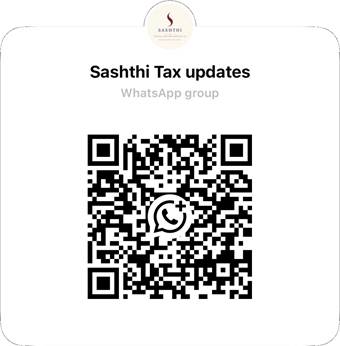
Join the Sashthi Tax Updates WhatsApp group
Get free GST updates on your phone. Scan the QR code to become a member – free, or join via https://chat.whatsapp.com/G7xFSIvZADlKXa1HJRln5m.
For advice on how this amendment affects your business, write to contact@sashthitaxlegal.com or call +91 99521 84110.
Source: Notification No. 04/2026-Central Tax dated 26.10.2026 [F. No. CBIC-20001/1/2026-GST], amending Notification No. 13/2020-Central Tax dated 21.03.2020; rules 47A and 48(4) of the CGST Rules, 2017; sections 9(3), 9(4), 13(3), 16(2) and 31(3)(f) of the CGST Act, 2017. This article is for general information and does not constitute professional advice. Readers should obtain specific advice before acting on any matter discussed here.